4.5
Which norm: Eα versus EB
The formula for E only asks for a norm on twist differences Δz = (Δω, Δv) that comes from an inner product. Two are offered, and the subscript on E says which one is inside.
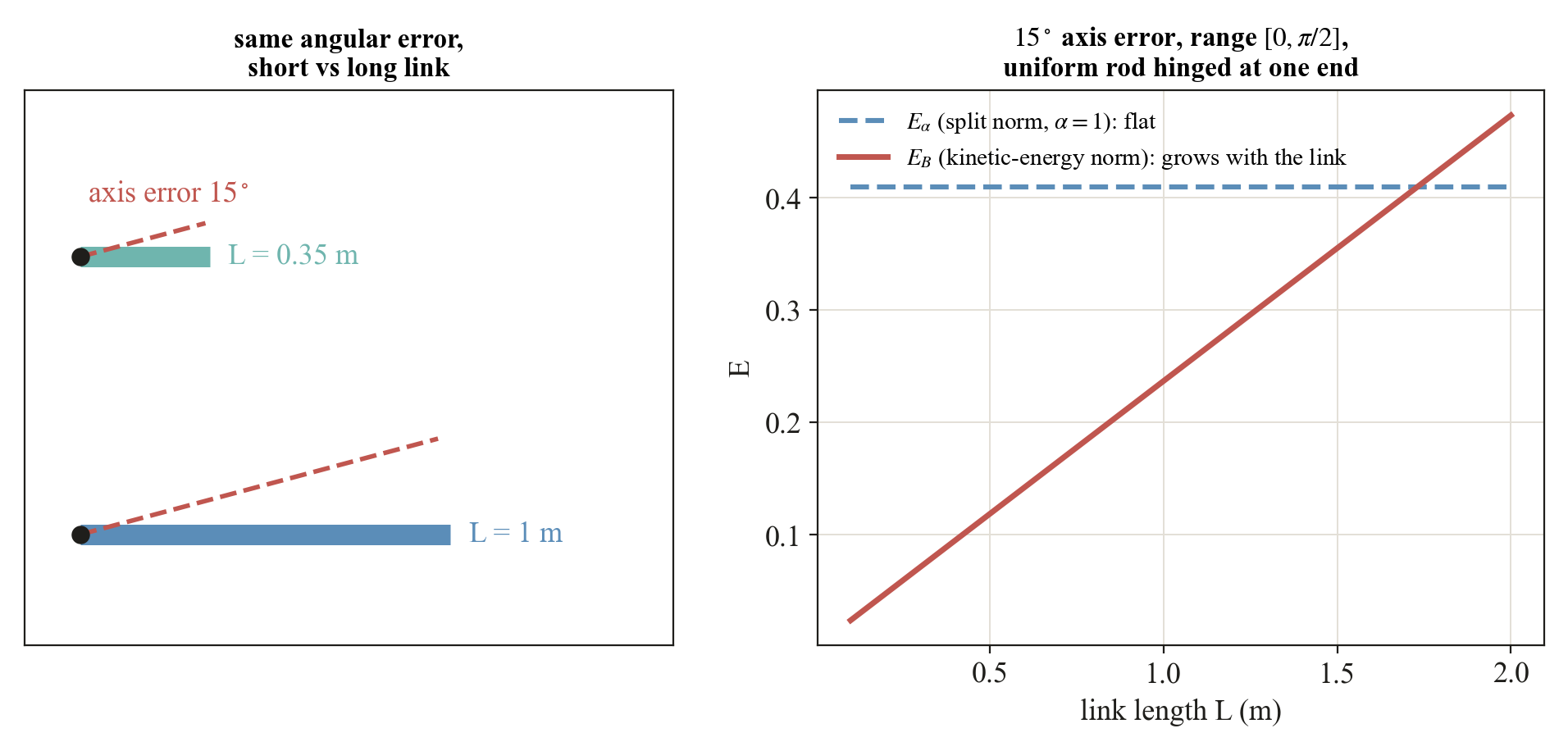
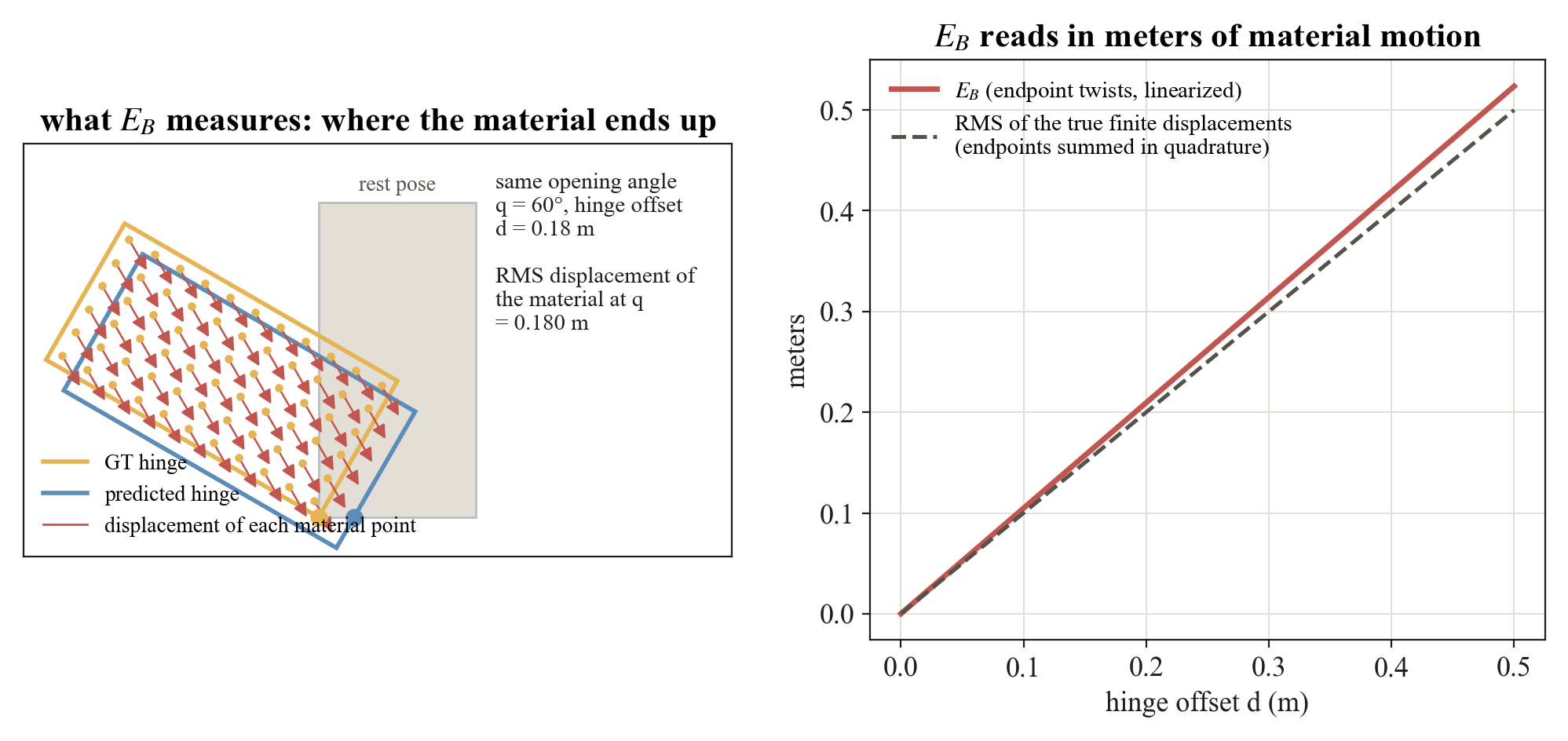
The split norm ‖Δz‖α² = ‖Δω‖² + α²‖Δv‖² weighs rotation against translation through one inverse length α. It needs no geometry, is dimensionless, and compares every joint of every object by one rule. The kinetic-energy norm ‖Δz‖B² = (1/m) Δωᵀ I Δω + ‖Δv + Δω × c‖² lets the moving link set the scale: m, c, and I are the mass, center of mass, and inertia of the ground-truth child link. Under it EB is in meters and equals the RMS linearized motion of the link's material.
α is a size assumption. For a centered link with isotropic inertia and gyration radius r, the kinetic norm equals r² times the split norm at α = 1/r. A global α therefore assumes every link has the same size 1/α. The object-scale ablation shows the consequence: EB(s) = s EB(1) under a uniform scaling s, while Eα is flat on angular errors.
EB is still a metric. The body B is fixed by the ground truth before any prediction is seen and is the same for every method on that joint, so the norm is one fixed inner-product norm and the quotient argument applies verbatim. Different ground-truth joints carry different norms, which is the intended physical weighting.
Units. Eα is a pure number, EB is meters. Never compare their heights, only their shapes.