4.7
Trees: Etree and the assignment relaxation
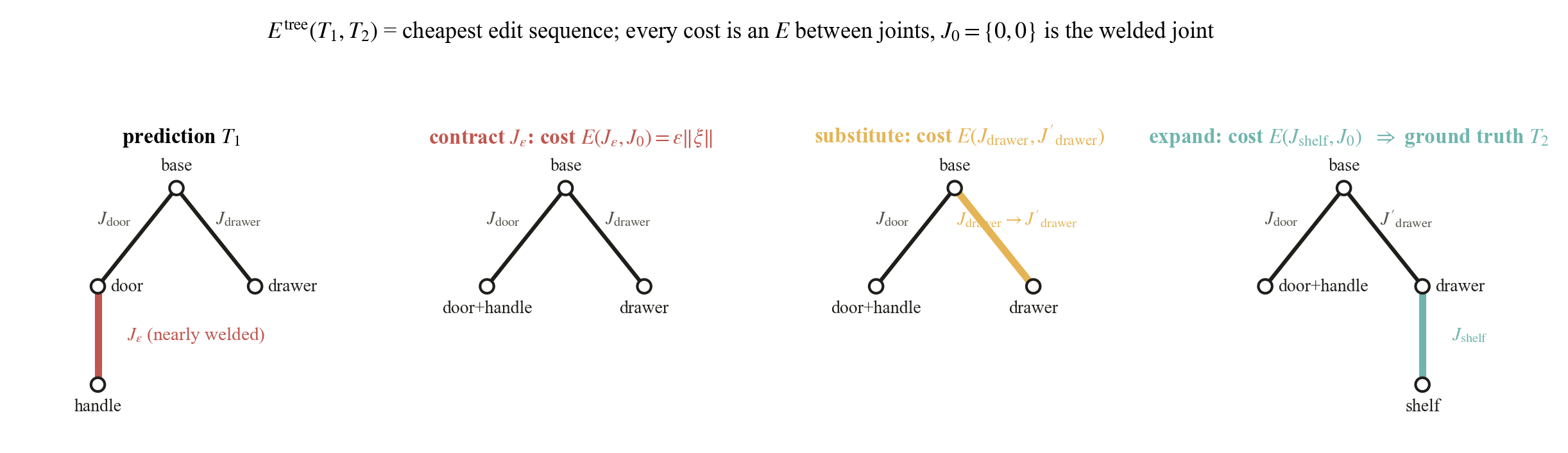
An object is a tree with links as nodes and joints on the edges, and the same object admits many
trees: parts can be relabeled, the base re-chosen, a handle welded to a drawer or split off. The tree
metric is the cheapest sequence of edits from one tree to the other,
Etree(T₁, T₂) = infπ Σo∈π c(o), with
substitution costing E(J, J′) and contraction or expansion costing
E(J, J₀). A spurious joint that barely moves costs
ε‖ξ‖, not a constant penalty, so topology errors and joint errors are priced in
the same motion currency and the metric is continuous through the welded boundary. Exactly fixed edges
are contracted first (contract_small_edges) because they are representation noise.
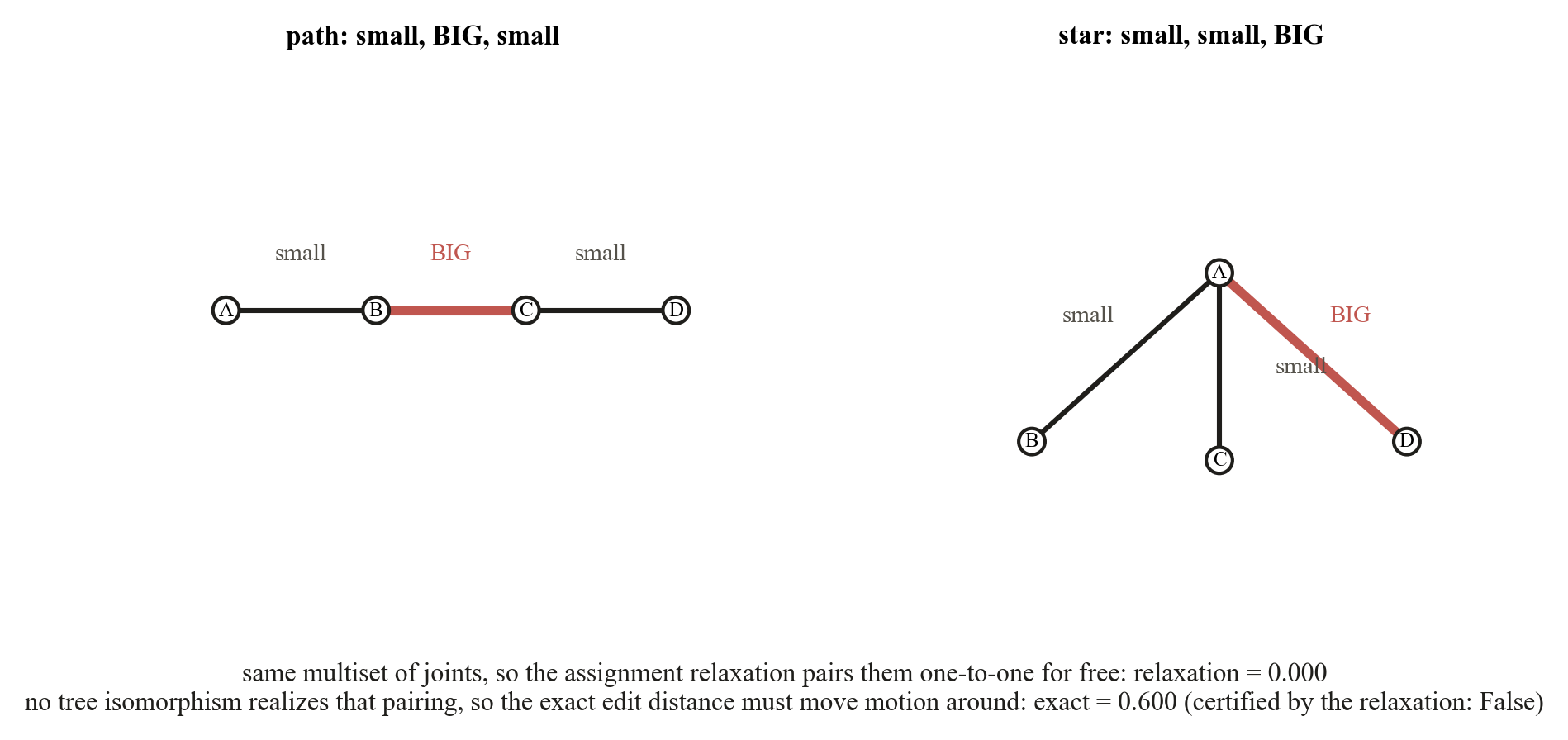
Any edit sequence can be reordered into contract, then substitute along a tree isomorphism, then
expand. The exact distance is therefore a minimum over matchings of the edge sets that extend to an
isomorphism of the contracted trees. Dropping that realizability condition gives the
assignment relaxation: a Hungarian matching over the joint multisets with
E(J, J₀) as the unmatched cost (assignment_tree_distance). It is
always a lower bound, it is polynomial for any input, and it needs only the multiset of predicted
joints. Whenever its optimal matching happens to be realizable, checked in linear time by
matching_realizable, the relaxation certifies the exact value.
exact_tree_distance returns (distance, certified) and falls back to a small
constrained search otherwise.
Why not a constant topology penalty λ. It jumps by λ the moment a joint appears, is capped at 2λ once unmatching becomes cheaper than matching, and the forced-matching variant escapes the cap only by breaking the triangle inequality. Motion-priced edits have no knob and none of these failures.
The per-link weighting and the metric proof. With one fixed inner product Etree is a metric on representation-equivalence classes. With the kinetic-energy norm instantiated per ground-truth link, contraction and expansion change which body weighs which joint, so that variant is used as a score without the metric claim.