4.3
The metric E and the ℤ₂ swap
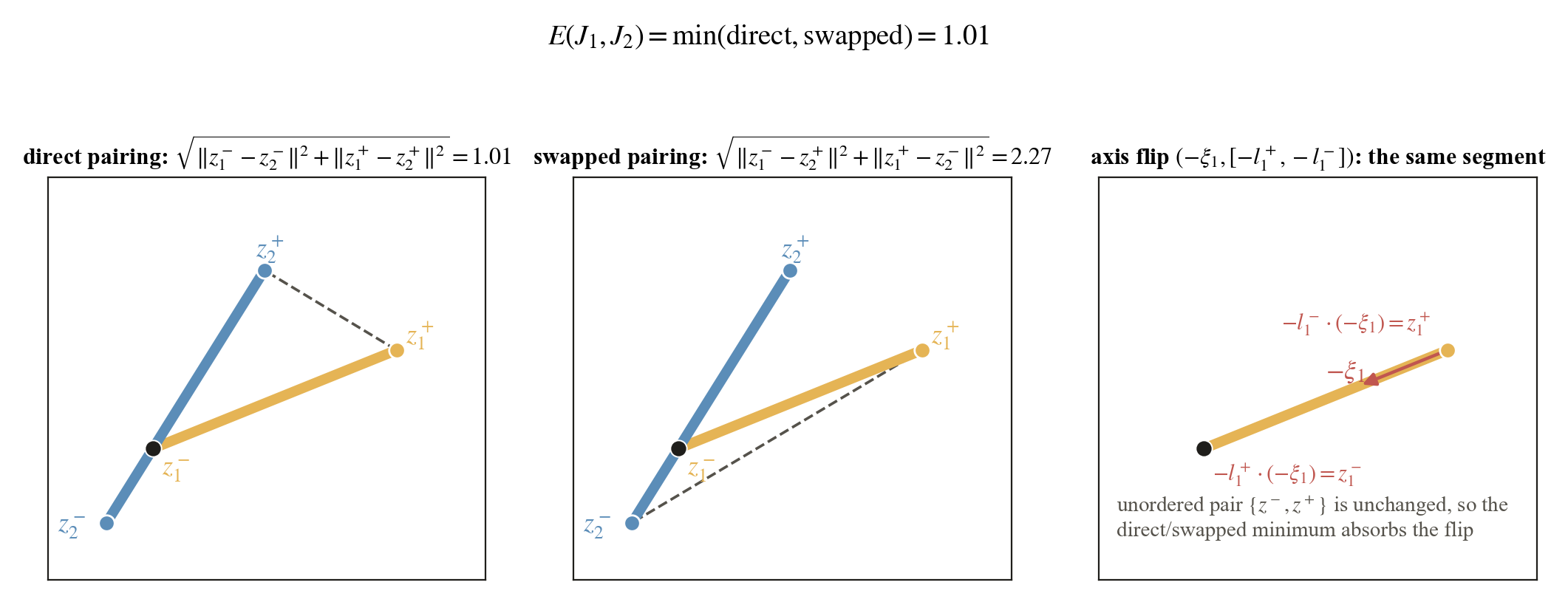
Two unordered pairs can be matched in two ways, direct (z₁⁻ ↔ z₂⁻, z₁⁺ ↔ z₂⁺) or swapped. Each way has a flat distance in se(3) × se(3), the square root of the two squared endpoint differences, and
E(J₁, J₂) = min{ ‖z₁⁻ − z₂⁻‖² + ‖z₁⁺ − z₂⁺‖², ‖z₁⁻ − z₂⁺‖² + ‖z₁⁺ − z₂⁻‖² }1/2.
This is the quotient distance of a flat space by the group ℤ₂ acting as the swap, and a quotient by a finite group of isometries is again a metric. That single fact gives the triangle inequality, which no hand-built combination of component errors has.
What the swap buys. Reversing the screw orientation maps
(ξ, [l⁻, l⁺]) to (−ξ, [−l⁺, −l⁻]). The two endpoint
twists are unchanged as a set, only their labels trade places, so the swapped pairing scores zero
against the original. The axis-sign ambiguity that breaks the prior limit score is removed
structurally, not patched.
Squares then a root, not a sum of norms. The two endpoint differences are combined in quadrature. This is what makes E the flat distance of the product space and what makes EB an RMS quantity later.
Where E is not smooth. Only on the tie locus where the two pairings cost the same. For training,
Squares then a root, not a sum of norms. The two endpoint differences are combined in quadrature. This is what makes E the flat distance of the product space and what makes EB an RMS quantity later.
Where E is not smooth. Only on the tie locus where the two pairings cost the same. For training,
training_loss replaces the min by a smooth swap-invariant surrogate.