4.2
The endpoint pair
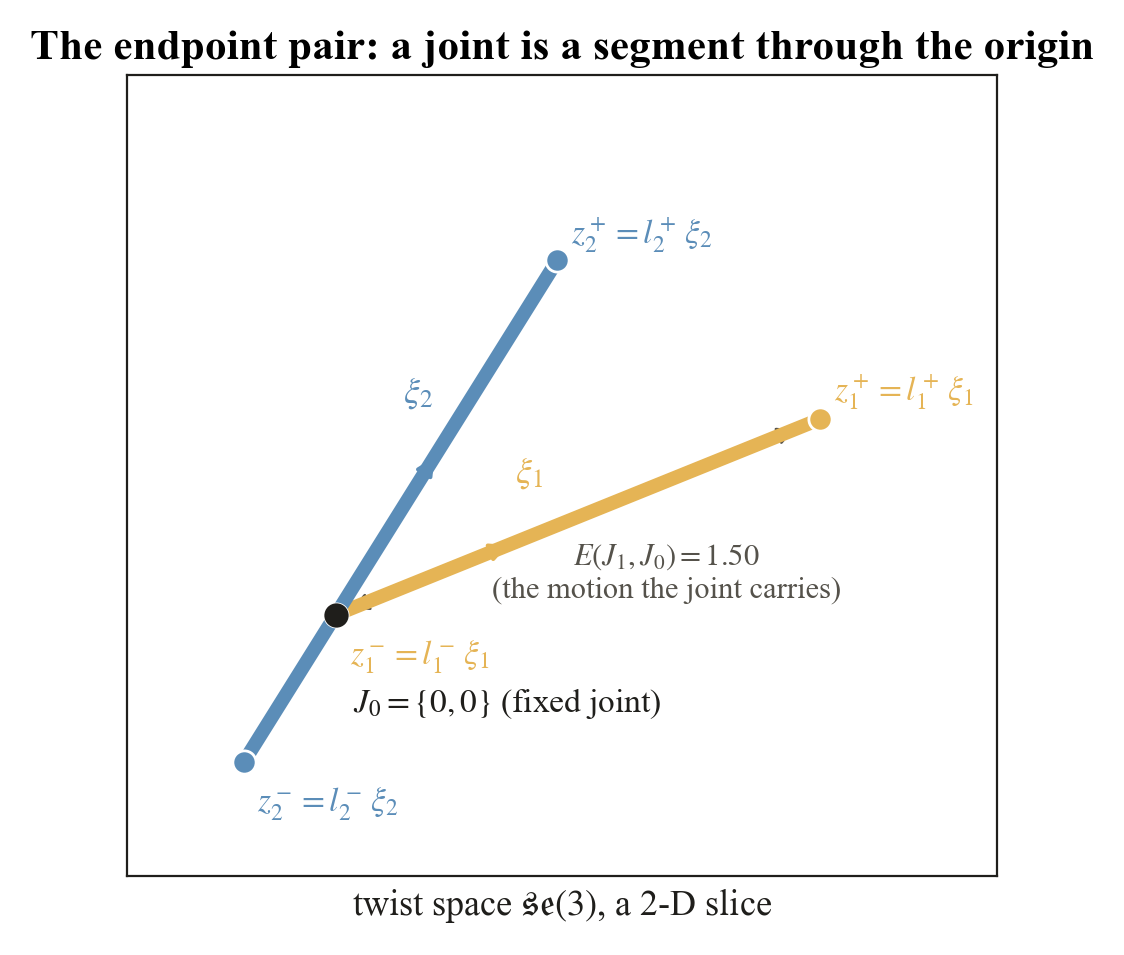
Multiply the unit twist by the two limits and the joint becomes a pair of points in se(3), {z⁻, z⁺} = {l⁻ ξ, l⁺ ξ}. The direction of the segment is the screw, its length is the range, its position along the line is where the range sits relative to the anchor. Nothing about the joint is lost and nothing about it is duplicated. The segment passes through the origin whenever l⁻ ≤ 0 ≤ l⁺, that is, whenever the stored state is inside the range. The fixed joint is the degenerate segment {0, 0}.
Limits are first-class data. The prior template folds the limits into the axis through a
motion vector a (l⁺ − l⁻), which keeps the range width but forgets where the
range sits and which way it points. The endpoint pair keeps both.
Why an unordered pair. Nothing physical distinguishes the two ends of a segment. Ordering them would make the metric depend on which limit is called lower, which is exactly the sign convention the next section removes.
E(J, J₀) is the "size" of a joint. Under the split norm it is √((l⁻)² + (l⁺)²) times a fixed factor, and under the kinetic-energy norm it is the RMS material displacement over the range. The tree metric prices structural edits with it.
Why an unordered pair. Nothing physical distinguishes the two ends of a segment. Ordering them would make the metric depend on which limit is called lower, which is exactly the sign convention the next section removes.
E(J, J₀) is the "size" of a joint. Under the split norm it is √((l⁻)² + (l⁺)²) times a fixed factor, and under the kinetic-energy norm it is the RMS material displacement over the range. The tree metric prices structural edits with it.