4.1
A joint is a twist
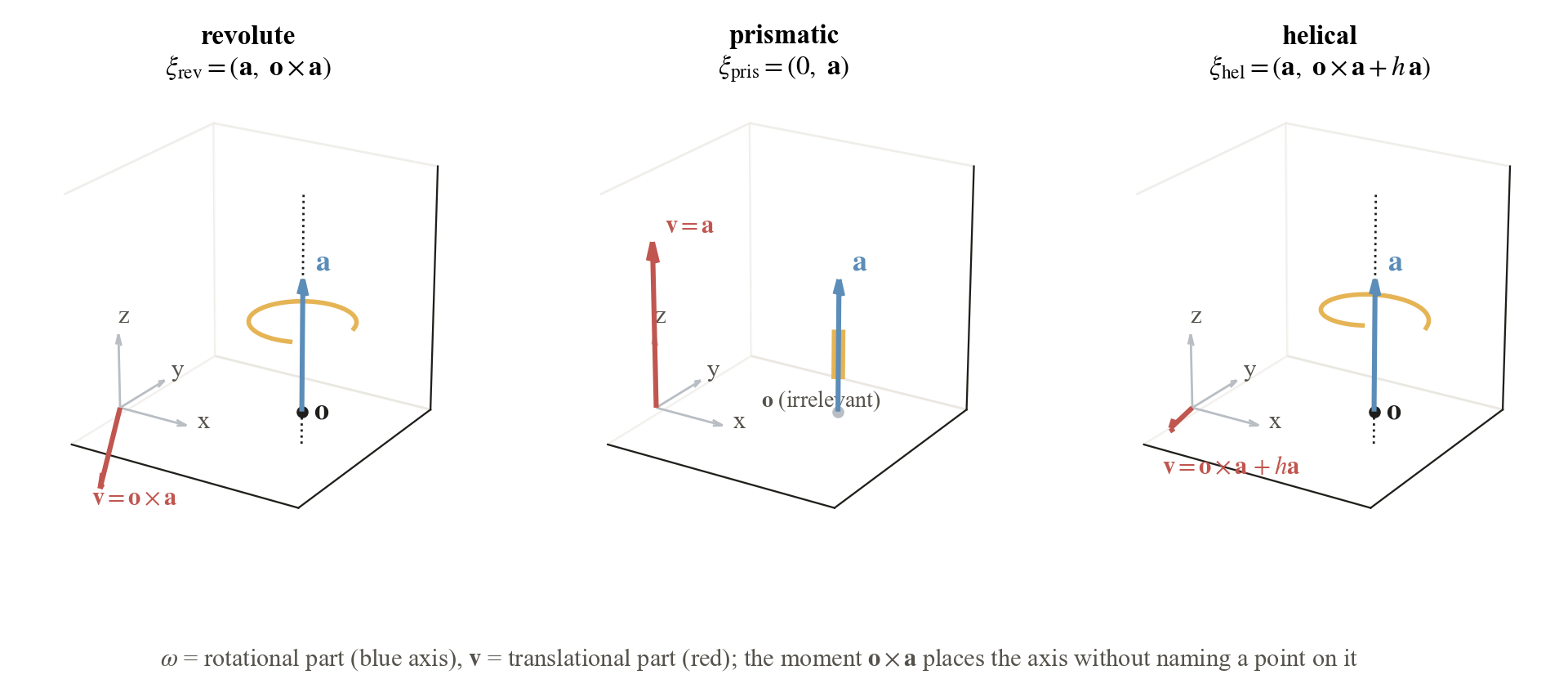
A URDF describes a joint with four separate things: a type, an axis direction a, an origin o, and limits. The first three are really one object, an infinitesimal rigid motion, and that object is the twist ξ = (ω, v). A revolute joint rotates about the line through o with direction a, which is ξrev = (a, o × a). A prismatic joint slides along a and has no rotation at all, ξpris = (0, a). A helical joint adds a translation of h meters per radian along the axis, ξhel = (a, o × a + h a). Flowing along ξ for q units gives the placement exp(q ξ̂) g₀ of the child link, where g₀ is the placement stored in the file.
Why the moment instead of the origin. The term o × a is the same
for every point o on the axis line, so the twist encodes the line itself and
not an arbitrary point picked on it. That is why two annotations of the same hinge with different
origin points on the same line produce identical twists.
Why "unit". The twist is normalized so that q carries the physical unit: radians for rotation, meters for translation. The limits are values of q and inherit that unit.
The anchor is shared data. Prediction and ground truth describe the same object in the same stored state, so g₀ is not something the kinematic metric judges. Re-zeroing q is not free because it moves the anchor, which the stored meshes pin down.
Why "unit". The twist is normalized so that q carries the physical unit: radians for rotation, meters for translation. The limits are values of q and inherit that unit.
The anchor is shared data. Prediction and ground truth describe the same object in the same stored state, so g₀ is not something the kinematic metric judges. Re-zeroing q is not free because it moves the anchor, which the stored meshes pin down.